Showing posts with label winter. Show all posts

January 21, 2020

How Plants Survive the Winter: Ice and Snow

by Toni Leland

Have you ever wondered how the trees and shrubs and perennials manage to live through each winter? Think about it. If they hadn’t adapted to those conditions, we’d live on a barren planet.
Rhododendron leaves in freezing weather
Rhododendron leaves curl up to prevent desiccation
from extreme cold weather and drying winds.


Our trees, shrubs, and perennials enter a period of dormancy as days shorten and temperatures cool in the fall. During this period, woody plants must have a certain number of hours of temperatures below 40˚F in order for them to come back in the spring. Many species in the Midwest and Northeast do not attain full dormancy until mid-November or December. Unexpected cold snaps in early fall or late spring will damage plants that either have not entered full dormancy, or have begun spring growth. A perfect example is the devastating effect of the unprecedented 2016 Polar Vortex, when temperatures dropped into the minus-single-digits for several nights in some places. The true consequences of this event might not be known for a couple of years.


Snow is good, but ice can be lethal

Not only does snow replenish the soil with moisture, but snow has great insulation properties that slow down the loss of heat from the ground. In an ideal winter, our plants have gone dormant long before the ground begins to freeze. Followed by a comfy blanket of snow, this frozen soil remains right around 32 degrees, and those plants and shrubs have a long rest before they’re required to perform again. Ice is quite another thing.


Thick ice on Japanese maple branches
Branches "glazed" with thick ice.

Ice storms, also known as “glaze storms” or “silver thaws,” can cause devastating damage to trees and shrubs. When surface temperatures remain at or below the freezing point (32˚F/0˚C), rain freezes on contact, sometimes accumulating up to 1 inch. This heavy layer can increase the weight of a tree branch up to 30 times, making it prone to breakage. Add a strong wind, and the chances of losing an ice-covered branch increase exponentially. Branch loss also reduces the total leaf area, reducing the carbohydrate available to the roots. Exposed bark is subject to sunscald and infestation by stem borers and other insects, while breakage wounds are open to decay, fungi, and crown gall bacterium.


Which Plants are at Risk?

According to the United States Forest Service, trees with a conical form, or excurrent branching habit, and those species with less branch surface area are the least likely to sustain damage from ice accumulation. Horizontal branching seems to resist breakage better than upright branching. Fast-growing trees have brittle wood and develop V-shaped crotches that easily split.


Prevention or repair?

Nothing can be done to prevent damage to mature trees. However, planting storm-tolerant varieties in a new landscape is one way to guard against dealing with the ravages of ice and snow. Learn which local species will grace your landscape and survive the winter weather. Plan ahead when planting tall trees, positioning them at least 45 feet from overhead utility wires. Prune them regularly to establish a well-distributed crown branching habit. Occasional light pruning of older trees might help them resist ice damage. Weak branches and interior branches can be removed before winter sets in, but avoid late summer pruning which will stimulate new growth.


Protecting fragile shrubs with burlap
Young shrubs benefit from protection too.

Choose hardy native plants, and carefully assess their proposed location. Easily-injured broadleaf evergreens such camellia, azalea, rhododendron, holly, and daphne should be located on the north, northeast, or eastern side of a building or fence to protect them from wind and sun. Low places in the landscape create frost pockets and can accumulate excess moisture around the roots. Don’t place shrubs under the eaves of the house – snow and ice can slide off onto the plants, and overflowing gutters can drench shrubs in heavy ice during freezing weather.

For small upright evergreens with multiple leaders, such as arborvitae and juniper, or clump trees such as birch, protect them by wrapping the leaders together about two-thirds above the weak crotches, using something soft (strips of cloth, nylon stockings, etc.) Be sure to remove the strips in the spring. A professional arborist can prepare larger, wide-spreading trees by cabling the branches together.


Damage control

Andromeda shrub heavily weighted with snow
Andromeda branches bent low under snow.
When the worst of the weather has passed, do not try to remove ice or snow by beating the branches! Plants have some flexibility and the accumulation of ice or snow happened gradually. By knocking the weight off these branches, it causes them to snap back, which stretches and damages the circulatory system of the plant. If a branch is severely bent, you can try propping it up to prevent breakage, but do it gently. When the temperatures rise to above freezing, the snow will melt on its own. If ice accumulation is significant (half-inch or more), Iowa State University Extension suggests spraying the branches with COLD water to accelerate melting. Never use hot water.

When the snow has melted, remove broken branches as soon as possible to prevent further breakage or tearing of the bark. Trees don’t heal – the bark grows over the damaged area. Hence, proper cleanup of a broken stem is important. Smooth the ragged edges of the dead bark using a sharp knife, removing the bark back to its attachment point. Tree experts have determined that wound dressings neither prevent decay nor keep out insects. During a 13-year research project, Dr. Alex Shigo found that leaving the tree alone was more beneficial than applying wound dressings, and that many products such as shellac, paint, or roofing tar actually damaged the tree.


Can it be saved?
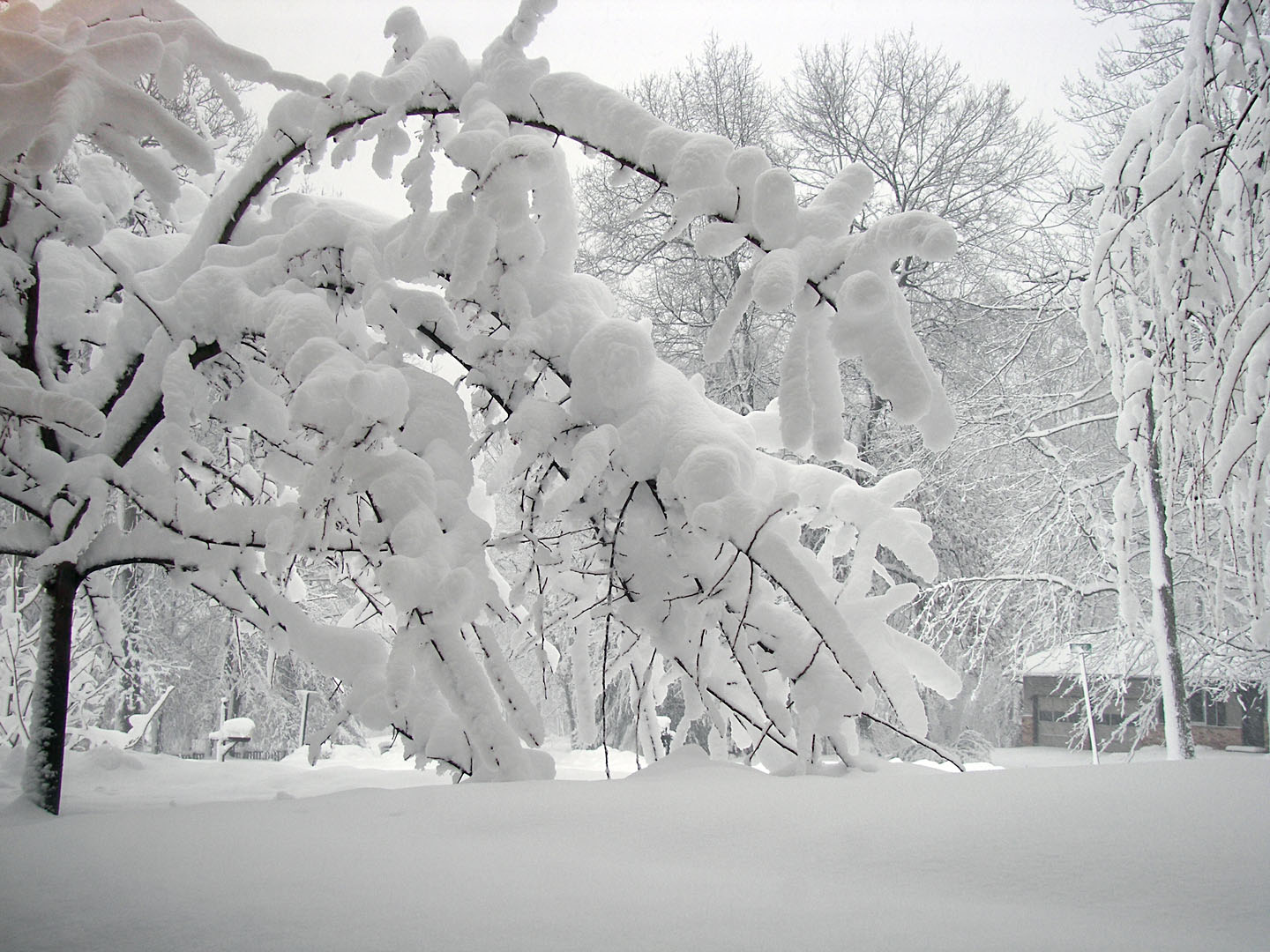
Trees heavily weighted with snow
The weight of snow and ice can sometimes uproot small to medium-sized trees. When the temperatures warm up, check to see if the tree can be straightened and saved. If one-half to one-third of the original root system is still in the soil, with the remaining exposed roots compact and undisturbed, it might be possible to set the tree upright and brace with guy wires. (University of Illinois Extension)

For catastrophic damage, major tree repair is expensive. If the tree is an important part of the landscape and more than 50% of its branches remain intact and undamaged, then the choice might be to save it. But if the condition of the tree is such that it will fall victim to either future weather or disease/insect damage, one must consider that into the decision. Large limbs can weigh over 2,000 pounds and most mature trees should be dealt with by professional tree services. 


When the storm is over and the repairs and removals are finished, be sure to continue evaluating and nurturing the recovery of damaged plants. Supplement rainfall to 1-inch per week, mulch to conserve moisture, and avoid excess soluble nitrogen fertilizer (less than 2 pounds actual nitrogen per 1,000 square feet, per University of Missouri Extension. Storm-damaged plants can be victim to insects and diseases, so check for symptoms and signs, then act quickly to minimize further damage.


Winter always comes in one form or another, and being knowledgeable and prepared for the worst is the best defense.


February 8, 2019

Visit Marsh Botanical Gardens at Yale University in New Haven, Connecticut

Sunflowers
by Toni Leland

Spring is just around the corner, but here in Connecticut, it's still quite chilly most days. 

What a treat to roam through the beautiful greenhouses at the Marsh Botanical Gardens at Yale University in New Haven. Four huge greenhouses filled with wondrous things!

Located on the estate of Othniel Charles Marsh, a renowned paleontologist and dinosaur discoverer, the gardens began in earnest in 1922 and flourished greatly during the thirties and early forties, many with the guidance of reknowned landscape architect Beatrix Jones Farrand. As is so often the case, changes in demographics affected the work forces and slowly caused the gardens to fall into neglect. In the 1990's, the gardens again became the focus of restoration and, from then on, have continued to improve and flourish again

To plan your own visit, see the link at the end of this post. Now, enjoy!

Our tour began with the Tropical Collection, a veritable treasure house of luscious colors, textures, shapes, and scents.
Passion Flower
Passion Flower (Passiflora 'Pura Vida Purple')
Canna Lily
Canna Lily (Canna cv 'Ermine')


Golden Shrimp Plant
Golden Shrimp Plant (Pachystachys lutea)


Costa Rican Butterfly Vine
Costa Rican Butterfly Vine (Dalechampia dioscoreifolia)


Protea
Protea (Protea)


Huperzia squarrosa
Huperzia squarrosa


In another part of this greenhouse, we saw familiar faces from our own gardens.
Columbine 'Denver Gold'
Golden Columbine (Aquilegia chrysantha cv 'Denver Gold')
Snake Plant or Mother-in-law's Tongue
Snake Plant (Sansevieria trifasciata)
Also known as Mother-in-law's Tongue
Fern leaf Dill
Who knew Dill could be so pretty?
Fern leaf Dill (Anethum graveleons cv 'Fernleaf')
Indian Mallow
Indian Mallow (Abutilon hybrid)
Outside this particular greenhouse, the staff has constructed an outdoor microclimate corner with a Koi pond and a camilia bush that was just about to bloom.
Koi
Interesting Koi–note the one on the far left that looks like a skeleton.
(photo courtesy Jennifer Carter)
Leaving the Tropical Collection, we proceeded to the interesting and sometimes creepy world of Carnivorous Plants. Some of the shapes and colors were straight out of a modern art class!
Venus Flytrap
Venus Flytrap (Dionaea muscipula)
Cobra Lily
Cobra Lily (Darlingtonia californica)


After petting Eli, the resident feline (who was the biggest cat I've ever seen), we moved into the Desert House. 
Succulents & Cacti
Succulents & Cacti need little water
Dozens of different cacti and succulents thrive in this beautifully-designed setting.


The outdoor gardens were, of course, still sleeping. But a return visit is planned when spring really gets here.

Where? Marsh Botanical Gardens
Yale University, New Haven, CT

Marsh Botanical Gardens

January 30, 2019

Gardening Alternative: Cooking

by Toni Leland

2019 and already kissing February. I've been thinking about what I'll do once the snow is gone and the ground warms up and things start to grow, and, and, and...

Winter is tough for those of us who want to be out in the garden, but these indoor months lend themselves to comfort activities - like cooking! I love to cook and bake, and it takes my mind off the fact that, other than dreaming about it, I can't be in the yard.

I'm crazy about vegetables and whole grains, and winter seems to lend itself to hearty dishes. I also love the vibrant flavors of cuisines from other lands—India, Asia, Mexico—and there are dozens of great cookbooks and online recipes to help satisfy my craving.

Vibrant India cookbook Chitra AgrawalOne of my favorites is Vibrant India by Chitra Agrawal, chef and owner of Brooklyn Delhi. Agrawal has captured the heart and essence of South India with the foods, cultures, and history which fill every page. Featuring fresh vegetarian recipes from Bangalore to Brooklyn, this book is an entertaining and fascinating exploration.

Through 216 pages, recipes and techniques cover breakfast and light meals; salads and yogurts; stir-fries and curries; rice and bread; soups, stews, and lentils; festive bites and snacks; sweets and drinks; and chutneys and pickles. Preparing several ingredients from scratch is outlined, as well as meal-planning and sample menus, a resource list for ingredients and equipment, and a complete index.

The photography in this book is beautiful, and the design is well thought-out with a simple typeface that is a reasonable size. Being a large hard-cover book, it’s a little unwieldy for a kitchen counter.

I loved this book and plan to try some of the intriguing dishes set forth, beginning with Roasted Butternut Squash and Lentil Stew. 

For anyone wishing to explore exceptional vegetarian cuisine, Vibrant India is the journey.
I received this book in exchange for my honest review.

January 7, 2019

’Tis the Season for Red Flowers and Berries!

by Toni Leland


I find it interesting that, as the winter months descend upon us, Mother Nature provides touches of red to brighten the barren landscape in many parts of the country. Here are some ideas to plant for brightening your own property next season.

American Holly (Ilex opaca)
Holly, of course, is well-known. Many of the evergreen hollies (Ilex spp.) with the prickly leaves and bright red berries are grown as foundation plantings to provide visual relief during the winter. Even after the birds have eaten all the berries, the glossy green leaves remain. But have you looked at the deciduous hollies?


American Winterberry (Ilex verticillata)
American Winterberry
This yummy Ilex verticillata - also known as American Winterberry - has lovely leaves and growth habit to enhance any garden or property, but they shine best when the temperatures begin to drop and the berries form. The leaves disappear, making room for plump, glorious berries that look good enough to eat. And these shrub specimens can be seen from blocks away!


Burning Bush (Euonymus alata)
Now, I know that many gardeners abhor Burning Bush (Euonymus alata) and sometimes with good reason: this imported shrub is invasive in many regions and I know, personally, that the shrub can overtake an area quickly if not controlled. But oh, look at this color in the late fall! And when the snow falls on the leafless shrubs, the tiny red berries look like jewels on cotton. 

Of course, these tiny red berries are very fertile and those left behind by the birds will each produce a tiny shrub in the spring. To maintain a Burning Bush for its beautiful foliage, yet prevent being overrun by babies, shearing the branches as the yellow flowers mature is an answer. Some of the dwarf cultivars are considered not so invasive.

So, when it's cold and gray outside, what can you use to brighten the inside of your home? Two brilliant red houseplants come to mind, and both arrive in November and usually last through January, if conditions are right.

The traditional "Amaryllis" bulb that appears in the stores
Hippeastrum 'Grand Cru'
around Thanksgiving is actually a genus of South American bulbs known as Hippeastrum, which are always grown indoors. (The true Amaryllis is a southern Africa bulb and is usually grown outdoors.) Though these bulbs come in several colors, the reds are magnificent! And watching them emerge and grow is fascinating.


Poinsettia 'Jingle Bells'
Another gorgeous red houseplant is the traditional Poinsettia, with bright little yellow flowers (or cyathia) and velvety bracts (modified leaves) that now come in amazing combinations and colors. But if you're looking for red, that is the natural coloring. This link to my in-depth article will give you even more information on the history, cultivars, and care of your Poinsettias.

Do you have a favorite red winter plant?
All images and content ©Toni Leland


March 24, 2018

Beautiful Mural Art in New London, Connecticut

Ah Winter, you've overstayed your welcome.
With the landscape still filled with mounds of gray snow, and nothing even close to the suggestion of spring, here in New London, Connecticut we have some of the most wonderful murals to brighten up a winter stroll through town. Since there are no imminent gardening options on a bright, cold day, feast your eyes on these works by local artists—a perfect reflection of the maritime history, love of music, and diversity that abounds here.

This is only a sample of the works in New England's largest mural walk. Click here to learn more about the origin of this project. Plan a visit to New London and take the walking tour here.

The Great Sperm Whales by Jamie XV Wyland, 1993.

Racing Seahorses by Carolyn McNeil, 2010

One Place, Many Cultures by Russ Kramer & Katie Fogg, 2012
Jimmi Hendrix by Jamie XV, 2014


Hard Hat Painters by Michael McNabney & Troy Zaushny, 2012
Girl with a Pearl Earring by Greg Bowerman, 2001

Charles Nelson Memorial by Denny Rivera, 2014


Cabinet of Shells by Peter good & Jan Cummings, 2012

Songs of Our City by Mark McKee & Qimin Liu, 2012


February 16, 2018

Lyme Tick Alert February 2018

Don't be fooled by the winter weather we've had here in the Northeast. I just went for a quick walk through the woods behind my house and brought back 6 ticks! Four adults, two nymphs.

With fluctuating cold and warm weather, apparently the tick population is ready to begin its season. Take care to check yourself thoroughly after time spent in woods or grasslands. Read more about why we hate ticks.

Ugh. Now I'm all crawly-itchy!


Adult Tick